

What Is the Merchant Navy?
The Merchant Navy is the commercial shipping industry responsible for transporting goods, raw materials and passengers by sea. It includes container ships, cargo vessels, bulk carriers, oil tankers and other commercial vessels operating on domestic and international routes.
Unlike the Indian Navy, which is India’s naval defence force, the Merchant Navy is primarily involved in commercial shipping and maritime transportation.
Candidates can build careers in areas such as the Deck Department or Engine Department, depending on their education, course and career path. The Merchant Navy selection process 2026 generally includes eligibility verification, course selection, admission, medical examination, maritime training and, where applicable, sea service and competency examinations.
The exact process can vary according to the course and institute.
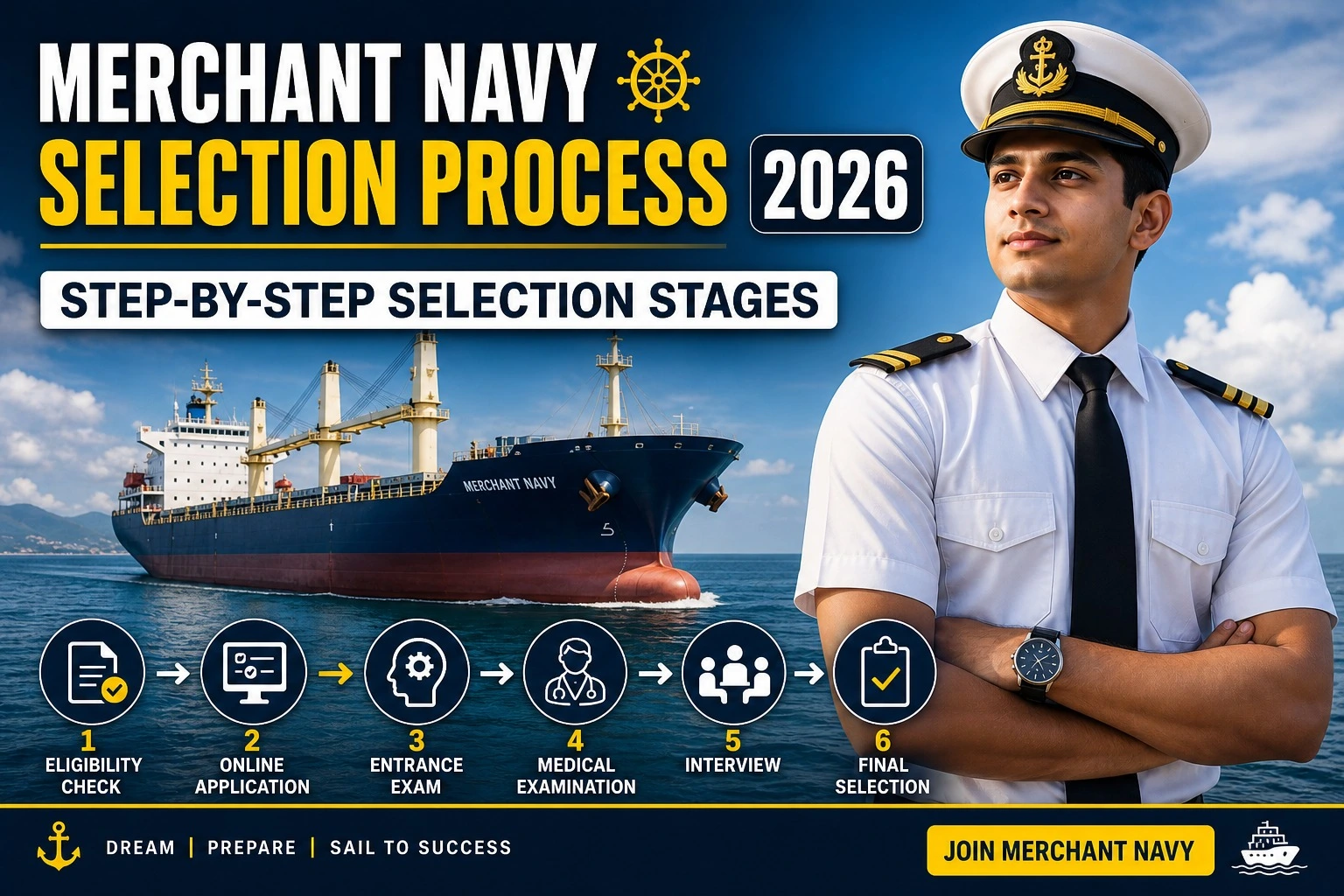
Merchant Navy Selection Process 2026
The major selection stages generally include:
- Check eligibility
- Select a suitable Merchant Navy course
- Submit the application
- Appear for an entrance examination, where applicable
- Complete the medical examination
- Complete document verification and counselling
- Undergo pre-sea training
- Complete required sea training
- Appear for applicable competency examinations
- Progress towards the required maritime certification
Candidates should always check the latest official notification because requirements differ between programmes.
Merchant Navy Selection Stages at a Glance
| Selection Stage | What Candidates Need to Do |
| Eligibility | Check education, age and other requirements |
| Course Selection | Choose a suitable maritime programme |
| Application | Submit the required application |
| Entrance Exam | Appear for the applicable examination |
| Medical Test | Complete the prescribed medical examination |
| Document Verification | Verify required documents |
| Admission | Complete counselling/admission formalities |
| Pre-Sea Training | Complete approved maritime training |
| Sea Training | Gain practical shipboard experience |
| Competency Exam | Complete applicable examinations |
| Certification | Obtain the required maritime certification |
Step 1: Check Merchant Navy Eligibility
The first step is to check the requirements for the selected course. Several undergraduate maritime programmes require candidates to have studied Physics, Chemistry and Mathematics (PCM) in Class 12.
For certain programmes, Indian Maritime University specifies requirements such as 60% aggregate marks in PCM and 50% in English. However, eligibility varies by programme and admission year.
Candidates should also check:
- Educational qualification
- Age limit
- English requirements
- Medical fitness
- Eyesight and colour-vision standards
Step 2: Choose the Right Merchant Navy Course
Candidates should select a course according to their intended career path. Common routes include:
- B.Sc. Nautical Science
- Diploma in Nautical Science (DNS)
- B.Tech Marine Engineering
- Other approved maritime programmes
Nautical courses are generally associated with deck and navigation careers, while marine engineering programmes focus on ship machinery and technical operations.
Step 3: Submit the Application
After selecting the course, candidates need to apply through the relevant admission process.
For applicable IMU programmes, candidates should use the official admission system and follow the current notification.
Applications may require:
- Name and date of birth
- Educational details
- Contact information
- Photograph and signature
- Identity proof
- Academic certificates
Candidates should carefully check every detail before submitting the application.
Step 4: Appear for the Entrance Examination
An entrance examination may be required depending on the course and admission route.
For applicable IMU undergraduate programmes, IMU-CET is an important entrance examination. Candidates should check the latest notification for the syllabus, exam date, eligibility, admit card, result and counselling information.
Not every Merchant Navy course follows the same entrance procedure.
Step 5: Complete the Medical Examination
Medical fitness is an important part of maritime education and employment.
The examination can cover:
- Eyesight
- Colour vision
- Hearing
- General physical fitness
- Other prescribed medical standards
Candidates should obtain the required medical certification from an appropriate approved medical practitioner. It is advisable to check medical eligibility before paying significant course or training fees.
Step 6: Document Verification and Counselling
After qualifying through the applicable admission process, candidates may have to complete document verification and counselling.
| Document | Purpose |
| Class 10 Certificate | Date of birth/basic qualification |
| Class 12 Marksheet | Educational eligibility |
| Identity Proof | Candidate verification |
| Photographs | Admission records |
| Entrance Documents | Admission verification |
| Medical Certificate | Medical fitness |
| Category Certificate | Applicable category verification |
The exact list depends on the institute and programme.
Step 7: Complete Pre-Sea Maritime Training
After admission, candidates undergo the required maritime education and training.
Training may cover:
- Seamanship
- Navigation
- Ship operations
- Maritime safety
- Emergency procedures
- Firefighting
- Personal survival techniques
- Technical subjects
Candidates should verify that the institute and programme are appropriately approved before making payments.
Step 8: Complete Shipboard Training
For relevant career routes, students gain practical experience onboard a vessel. This helps them understand actual ship operations and apply classroom knowledge.
Training may provide exposure to navigation, cargo operations, safety procedures, maintenance, emergency drills and watchkeeping.
The exact sea-training requirement depends on the course and intended certification.
Step 9: Appear for Competency Examinations
Completing a maritime course does not automatically make a candidate a senior officer.
Officer-level career paths can require prescribed sea service, additional training and competency examinations. The Directorate General of Shipping (DG Shipping) provides information regarding maritime examinations, training and certification.
Step 10: Obtain the Required Certification
After completing the required education, training, sea service and examinations, candidates can progress towards the relevant maritime certification.
Requirements depend on the department, position and certification being pursued. Candidates should therefore check the latest DG Shipping requirements for their specific pathway.
Important Official Portals for Merchant Navy Candidates
| Portal / Authority | What to Check |
| Directorate General of Shipping | Training, certification, examinations and notices |
| Indian Maritime University | Courses, admissions and IMU-CET |
| IMU Admissions | Applications, counselling and admission updates |
| Approved Maritime Training Institutes | Course and training details |
Candidates should rely on official sources for current eligibility, admission dates and training requirements.
Merchant Navy Selection Process 2026: Important Dates
Merchant Navy admissions do not have one common deadline for every course and institute.
For the IMU 2026–27 admission cycle, the university issued an academic circular dated 31 August 2026 regarding closure of admissions for the academic year 2026–27.
| Update | Date / Status |
| IMU 2026–27 admission cycle | Official admission cycle conducted |
| Admission closure circular | 31 August 2026 |
| Future admission planning | Check the next official notification |
Private shipping companies, sponsorship programmes and maritime institutes can follow different schedules.
Is Merchant Navy Admission Open Right Now?
Candidates should check the status of the specific course or recruitment programme before applying. There is no single application covering every Merchant Navy course and job.
Before paying any fee, verify:
- Institute approval
- Course approval
- Application deadline
- Medical requirements
- Sponsorship conditions
- Placement or employment terms
- Refund policy
Candidates should be cautious about websites promising guaranteed Merchant Navy jobs without providing clear official recruitment details.
Merchant Navy Selection Process After 12th
Students planning to join after Class 12 should first identify their preferred career route.
Deck career:
Class 12 → Eligible nautical course → Admission/entrance process → Medical fitness → Maritime training → Sea training → Required examinations → Certification
Marine engineering career:
Class 12 PCM → Eligible engineering programme → Admission → Medical fitness → Marine engineering training → Sea service → Required examinations → Certification
The exact pathway depends on the selected programme and current requirements.
Common Mistakes to Avoid
- Applying without checking eligibility
- Ignoring medical requirements
- Selecting an unverified training institute
- Paying unknown recruitment agents
- Assuming every course has the same entrance examination
- Believing guaranteed-job or unrealistic salary claims
- Using outdated admission dates
- Failing to check DG Shipping and IMU information
Merchant Navy Selection Process 2026 FAQs
What is the Merchant Navy selection process?
It can include eligibility verification, course selection, application, entrance examination where applicable, medical examination, document verification, maritime training, sea training and competency certification.
Can I join the Merchant Navy after Class 12?
Yes. Several maritime education pathways are available to eligible Class 12 students, particularly those meeting the required PCM and other course-specific conditions.
Is IMU-CET compulsory for Merchant Navy?
IMU-CET applies to relevant IMU programmes, but there is no single entrance examination applicable to every Merchant Navy course or recruitment route.
Is a medical test required?
Candidates entering relevant maritime programmes need to meet the applicable medical standards, which can include eyesight, colour vision, hearing and general fitness.
Does a Merchant Navy course guarantee a job?
No. Education and training are separate from employment. Candidates should check the actual sponsorship, recruitment and placement conditions of the programme.
What is the difference between Merchant Navy and Indian Navy?
The Merchant Navy is primarily associated with commercial shipping and transportation, while the Indian Navy is India’s naval defence service. They are separate career fields.