


Introduction
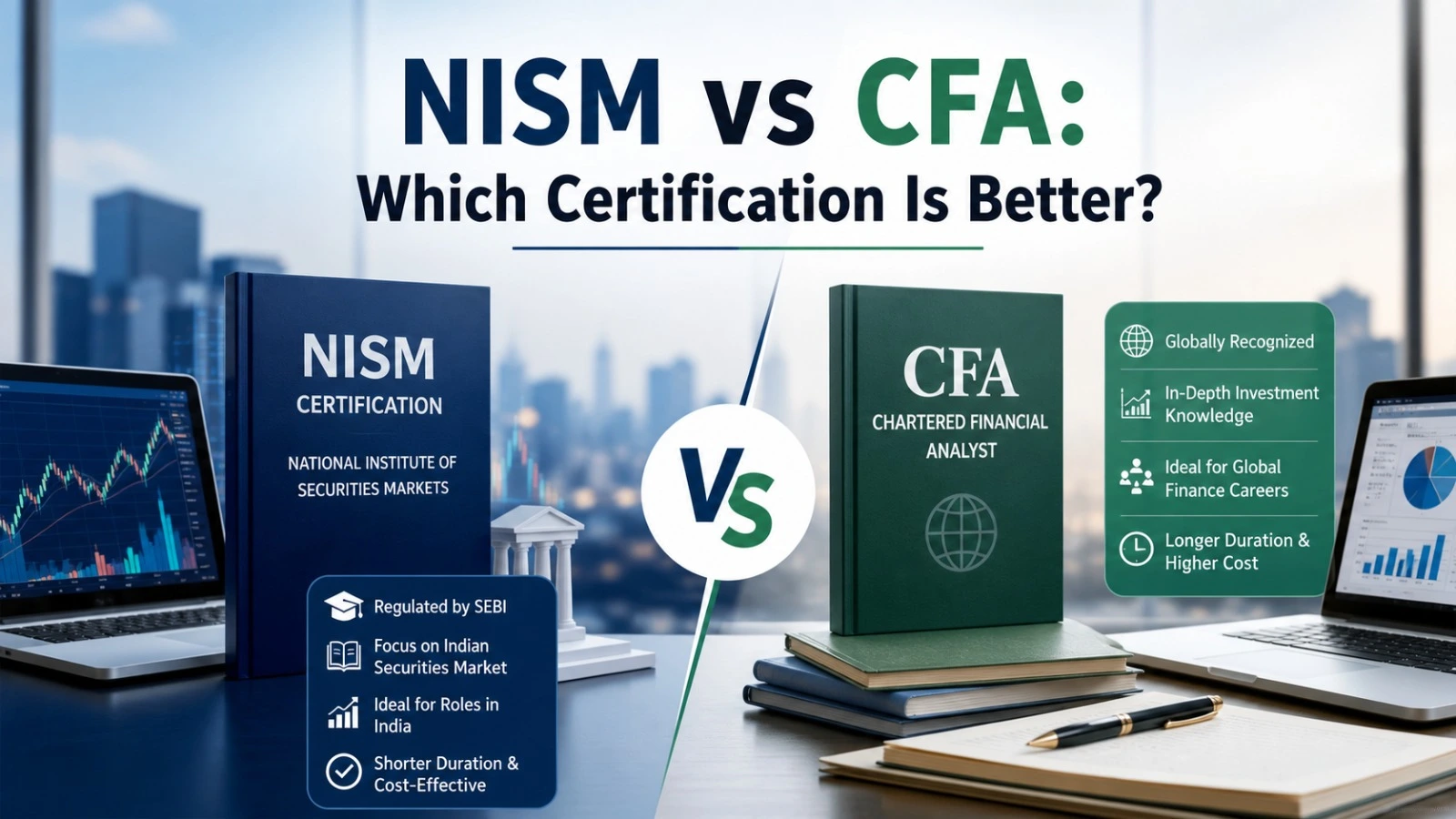
Choosing between NISM and CFA can be confusing for students, freshers and working professionals who want to build a career in finance. Both certifications are valuable, but they serve different purposes. NISM focuses on India’s securities markets, while CFA provides in-depth knowledge of investment analysis, portfolio management and financial valuation.
The best certification depends on your career goals, budget and the type of finance job you want. Here is a detailed comparison to help you make the right decision.
What Is NISM Certification?
The National Institute of Securities Markets (NISM) offers certification examinations covering different areas of India’s securities market. It was established by the Securities and Exchange Board of India (SEBI) to improve knowledge and professional standards in the financial industry.
NISM offers certifications related to mutual funds, equity derivatives, research analysis, investment advisory and securities operations. Some certifications are required for specific roles under applicable regulatory rules, while others help candidates develop specialised knowledge.
Official website: https://www.nism.ac.in/certifications/
What Is the CFA Program?
The Chartered Financial Analyst (CFA) Program is offered by CFA Institute. It is designed for individuals interested in investment research, financial analysis, asset management and portfolio management.
The program has three examination levels covering subjects such as economics, financial statement analysis, equity investments, fixed income, portfolio management and professional ethics.
Passing the examinations alone does not automatically make someone a CFA charterholder. Candidates must also satisfy the applicable work experience and membership requirements.
Official website: https://www.cfainstitute.org/programs/cfa-program
NISM vs CFA: Key Differences
| Feature | NISM | CFA |
| Main focus | Indian securities markets | Investment analysis and portfolio management |
| Recognition | Indian financial market | International investment industry |
| Structure | Multiple specialised certifications | Three examination levels |
| Cost | Varies by examination | Higher overall investment |
| Duration | Depends on the selected certification | Usually a multi-year commitment |
| Best for | Market-specific roles and relevant regulatory requirements | Investment research and analytical finance careers |
NISM vs CFA Fees and Duration
NISM is generally more affordable for candidates who want to learn a specific financial-market subject. Examination fees vary depending on the certification, and many certificates have a defined validity period.
The CFA Program requires a larger financial and time commitment. CFA Institute’s published 2026 examination-fee structure puts the combined fees for all three levels at approximately USD 3,520–4,570, excluding additional expenses such as applicable taxes and preparation materials.
| Information | Official source |
| NISM examination fees and validity | https://www.nism.ac.in/certifications/ |
| CFA examination fees and dates | https://www.cfainstitute.org/programs/cfa-program/dates-fees |
| CFA eligibility requirements | https://www.cfainstitute.org/about/governance/policies/cfa-exam-eligibility-policy |
Always verify current fees and eligibility before registering.
Career Opportunities After NISM
NISM can be useful for candidates interested in India’s securities-market ecosystem. Depending on the certification and other qualifications, potential career paths include:
- Mutual fund distribution and support
- Securities operations
- Equity and derivatives market support
- Compliance-related roles
- Research analyst pathways, subject to applicable requirements
For example, candidates interested in securities research can explore the NISM Series XV Research Analyst examination. However, completing a certification does not automatically grant every required regulatory authorisation.
Career Opportunities After CFA
The CFA Program may be suitable for people targeting investment-focused careers, including:
- Equity research analyst
- Investment analyst
- Portfolio analyst
- Asset management professional
- Fixed-income research analyst
- Investment risk analyst
Career outcomes depend on practical skills, experience, qualifications and employer requirements. Neither certification guarantees employment or a particular salary.
Which Is Better for Freshers?
For freshers, NISM may be a practical starting point if they want focused knowledge of Indian securities markets or need a specific certification for their target role.
CFA may be more suitable for graduates interested in company valuation, investment research and portfolio management who are prepared for a demanding curriculum and higher costs.
You can also pursue both at different career stages if they support your goals. Completing both is not compulsory.
Frequently Asked Questions
Is NISM better than CFA?
NISM is useful for specialised Indian securities-market knowledge, while CFA is designed for broader investment analysis and portfolio management. The better option depends on your career plans.
Can I do NISM after graduation?
Yes. Eligibility depends on the particular examination and intended role. Check the official NISM website for details.
Is CFA recognised in India?
Yes. CFA is recognised internationally and can be relevant to investment and analytical finance roles in India.
Which certification should I choose first?
Choose NISM for a specific Indian market-related requirement or focused learning. Consider CFA if your long-term goal is investment research or portfolio management.
Final Verdict
Choose NISM for specialised Indian securities-market knowledge and relevant certification requirements. Choose CFA for investment analysis, financial valuation and portfolio-management careers.
Before enrolling, compare the official syllabus, fees and job requirements. Selecting a certification that matches your career goal is more valuable than choosing one simply because it is popular.