

Introduction
Choosing the right Merchant Navy course after Class 12 is an important decision for students who want to build a career in the maritime industry. The Merchant Navy offers opportunities in ship navigation, marine engineering, cargo operations and international shipping. However, students must select a course that matches their interests, academic background and career goals.
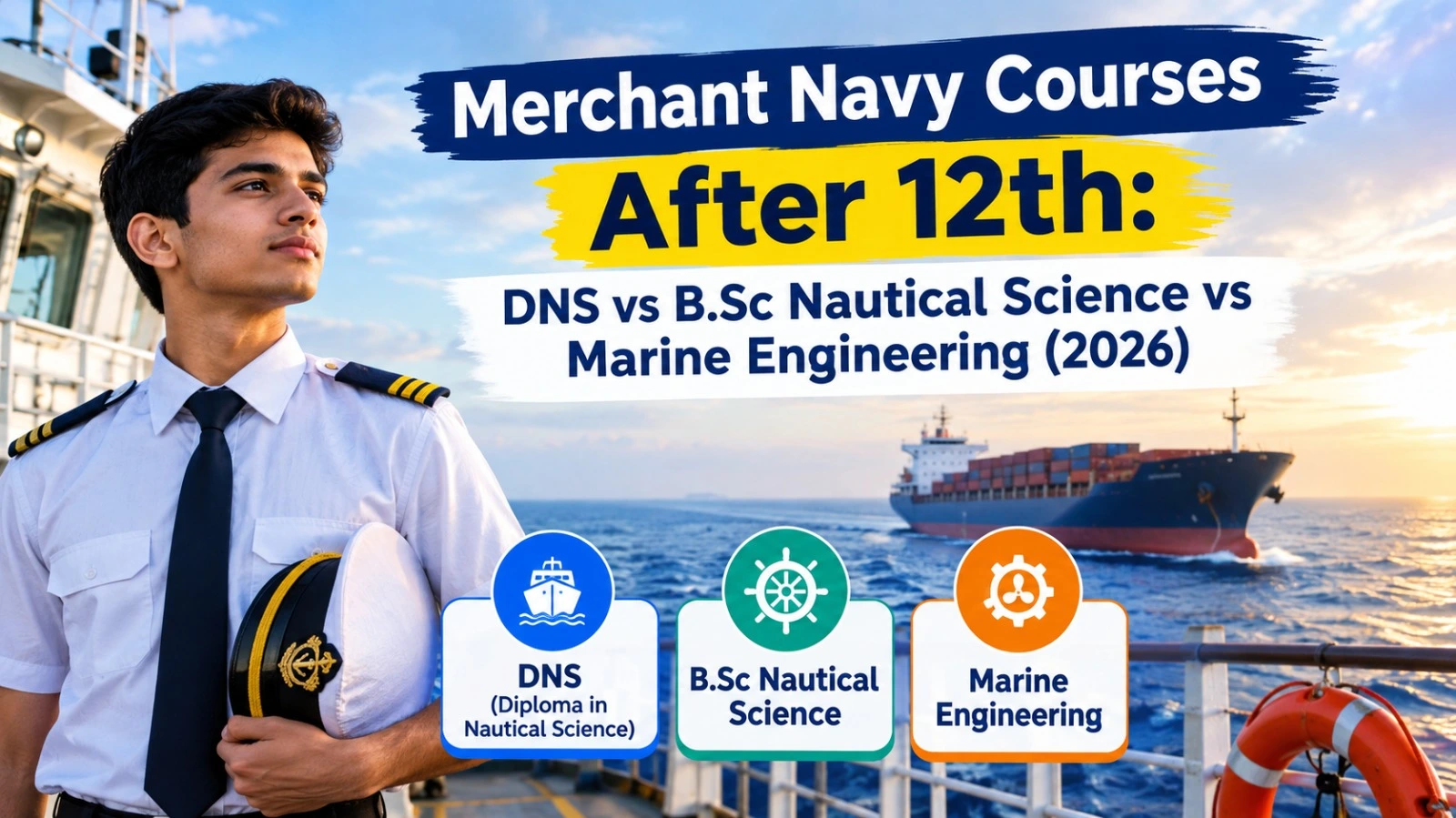
Three popular options are the Diploma in Nautical Science (DNS), B.Sc. Nautical Science and B.Tech. Marine Engineering. Although all three can lead to maritime careers, they prepare students for different responsibilities on a ship.
DNS and B.Sc. Nautical Science focus on navigation and deck operations, while Marine Engineering deals with engines, machinery and technical systems. Before applying for admission in 2026, students should compare course duration, eligibility, career opportunities and official admission requirements.
Merchant Navy Courses After 12th: Overview
| Course | Typical duration | Main specialisation | Career pathway |
| Diploma in Nautical Science (DNS) | Around 1 year of pre-sea training | Navigation and deck operations | Deck cadet to deck officer |
| B.Sc. Nautical Science | 3 years | Navigation and maritime operations | Deck cadet to deck officer |
| B.Tech. Marine Engineering | 4 years | Ship engines and machinery | Junior engineer to engineering officer |
Course structures and eligibility requirements may vary. Students should verify the latest rules through the relevant institute and the Directorate General of Shipping (DGS).
1. Diploma in Nautical Science (DNS)
The Diploma in Nautical Science is a popular option for students who want to enter the deck department of a merchant ship. The course provides pre-sea training in navigation, seamanship, ship safety and other essential maritime subjects.
A typical DNS programme includes approximately one year of pre-sea training, followed by the prescribed onboard training as a deck cadet. Students must complete the applicable sea-service requirements, examinations and certification procedures to progress towards becoming qualified deck officers.
Eligibility for DNS After 12th
Students generally need to meet the following conditions:
- Pass Class 12 with Physics, Chemistry and Mathematics (PCM).
- Meet the prescribed minimum marks in PCM and English.
- Satisfy the applicable age requirements.
- Meet medical fitness and eyesight standards, including colour-vision requirements.
- Fulfil the entrance examination and sponsorship conditions applicable to their admission route.
The exact eligibility criteria can change according to current regulations and institutional requirements.
Career Opportunities After DNS
After completing the required training, candidates can pursue deck-cadet opportunities. With the necessary onboard experience, competency examinations and certification, they may progress to officer-level positions and eventually aim to become a ship’s captain.
DNS may suit students who want a shorter initial pre-sea training period. However, candidates should carefully check company sponsorship, onboard training arrangements and institute approval before paying admission fees.
2. B.Sc. Nautical Science
B.Sc. Nautical Science is a three-year undergraduate programme for students interested in ship navigation and deck operations. It combines academic learning with practical maritime preparation.
The course generally covers navigation, meteorology, ship stability, cargo handling, maritime regulations, communication and safety procedures. These subjects help students understand how ships operate and how deck officers manage responsibilities at sea.
Eligibility for B.Sc. Nautical Science
Applicants generally need to:
- Complete Class 12 with Physics, Chemistry and Mathematics.
- Meet the prescribed PCM and English marks.
- Satisfy the applicable age and medical fitness requirements.
- Meet eyesight and colour-vision standards.
- Qualify through the applicable admission process, including IMU-CET where required.
Students should consult the latest Indian Maritime University (IMU) prospectus to confirm the current requirements before applying.
Career Opportunities After B.Sc. Nautical Science
After graduation, students must complete the relevant practical training and certification requirements to qualify for professional responsibilities at sea. Career progression may include deck-cadet training, officer positions and, with the required experience and competency qualifications, captain-level roles.
This course can be a suitable choice for students who prefer a full undergraduate degree with a focus on navigation. However, completing the degree alone does not automatically guarantee a job or a certificate of competency.
3. Marine Engineering After 12th
Marine Engineering is designed for students who enjoy mechanical systems, engines and technical problem-solving. The usual undergraduate option is a four-year B.Tech. in Marine Engineering.
Unlike Nautical Science, which focuses on navigation, Marine Engineering prepares students to understand, operate and maintain the technical systems that keep a ship functioning.
The curriculum typically includes marine diesel engines, thermodynamics, electrical systems, pumps, machinery maintenance, engineering principles and engine-room safety.
Eligibility for Marine Engineering
Students generally need to:
- Pass Class 12 with Physics, Chemistry and Mathematics.
- Meet the minimum marks prescribed by the university or institute.
- Fulfil applicable age and medical fitness standards.
- Meet eyesight requirements where applicable.
- Qualify through the prescribed entrance examination and admission process.
Candidates must check the current IMU prospectus or the relevant institute’s admission notice for exact eligibility criteria.
Career Opportunities After Marine Engineering
After completing the course and fulfilling the required training and certification conditions, graduates can pursue opportunities in the ship’s engine department. With appropriate sea service and competency examinations, they may progress through engineering officer ranks towards becoming a Chief Engineer.
Other potential career areas include ship management, marine equipment companies, shipyards, technical services and maritime engineering organisations.
Marine Engineering is worth considering if you prefer working with machinery, diagnosing technical problems and maintaining complex systems rather than focusing on navigation.
DNS vs B.Sc. Nautical Science vs Marine Engineering: Which Is Better?
The best course depends on your interests and the type of work you want to perform.
| Your career goal | Course to consider |
| Work in ship navigation and deck operations | DNS or B.Sc. Nautical Science |
| Pursue a three-year undergraduate programme focused on navigation | B.Sc. Nautical Science |
| Follow a shorter initial pre-sea training route | DNS |
| Work with ship engines and mechanical systems | B.Tech. Marine Engineering |
| Build a career in the engine department | B.Tech. Marine Engineering |
Students should not select a course only because it is shorter or advertised as offering a high salary. Training quality, institute approval, medical fitness, onboard experience and employment arrangements are equally important.
Merchant Navy Admission 2026: Official Websites
Use these official portals to check course information, admission notifications and training requirements.
| Official portal | Purpose | Website |
| Indian Maritime University | Courses, entrance examinations and prospectus | imu.edu.in |
| IMU Admissions | Admission notices and application information | IMU Admissions |
| Directorate General of Shipping | Maritime regulations and training information | dgshipping.gov.in |
| DGS Approved Training Institutes | Check the approval status of training institutes | Approved Institutes |
| DGS Medical Standards | Medical fitness requirements for seafarers | Medical Standards |
For 2026–27, students should review the relevant official prospectus and admission notices. Admission schedules can change, so check whether applications are currently open before making any payment.
Important Things to Check Before Admission
Before joining a Merchant Navy course, keep these points in mind:
- Verify course approval: Confirm that the institute and the specific programme have the required DGS approval.
- Check medical fitness: Understand the applicable medical examination, eyesight and colour-vision requirements before committing to the course.
- Understand sponsorship: Confirm whether company sponsorship is required for your chosen DNS route and obtain clear written information about any offer.
- Compare total fees: Include tuition, accommodation, uniforms, medical examinations and other expenses.
- Ask about onboard training: Understand how sea-time training is arranged and what happens if a training berth is delayed.
- Avoid unrealistic promises: Be cautious of advertisements guaranteeing jobs, placements or high salaries without verifiable evidence.
Frequently Asked Questions
Which Merchant Navy course is best after 12th?
DNS and B.Sc. Nautical Science are suitable options for students interested in navigation and deck operations. Marine Engineering is more appropriate for students who prefer ship machinery and technical work.
Can I join the Merchant Navy after 12th Science?
Yes. Students who meet the academic, medical, age and other applicable requirements can apply for eligible maritime courses after Class 12.
Is DNS better than B.Sc. Nautical Science?
DNS offers a shorter initial pre-sea training route, while B.Sc. Nautical Science is a three-year undergraduate degree. The better option depends on the admission pathway, training arrangements and personal career goals.
Does completing Marine Engineering guarantee a Merchant Navy job?
No. Completing the course does not automatically guarantee employment, onboard training or professional certification. Candidates must fulfil the relevant recruitment, training and certification requirements.
Conclusion
Merchant Navy courses after 12th offer different career pathways depending on whether you prefer navigation or engineering. DNS and B.Sc. Nautical Science focus on deck operations, while Marine Engineering prepares students for technical responsibilities in the engine department.
Compare eligibility, course duration, medical standards, fees and training arrangements before choosing a programme. Most importantly, verify current admission information through IMU and the Directorate General of Shipping. A carefully researched decision can help you choose a course that fits your interests and long-term maritime career goals.