


Introduction
Households planning to install rooftop solar panels can reduce their initial investment through the PM Surya Ghar: Muft Bijli Yojana. The Central Government scheme supports eligible residential electricity consumers who want to generate solar power at home and reduce their monthly electricity bills.
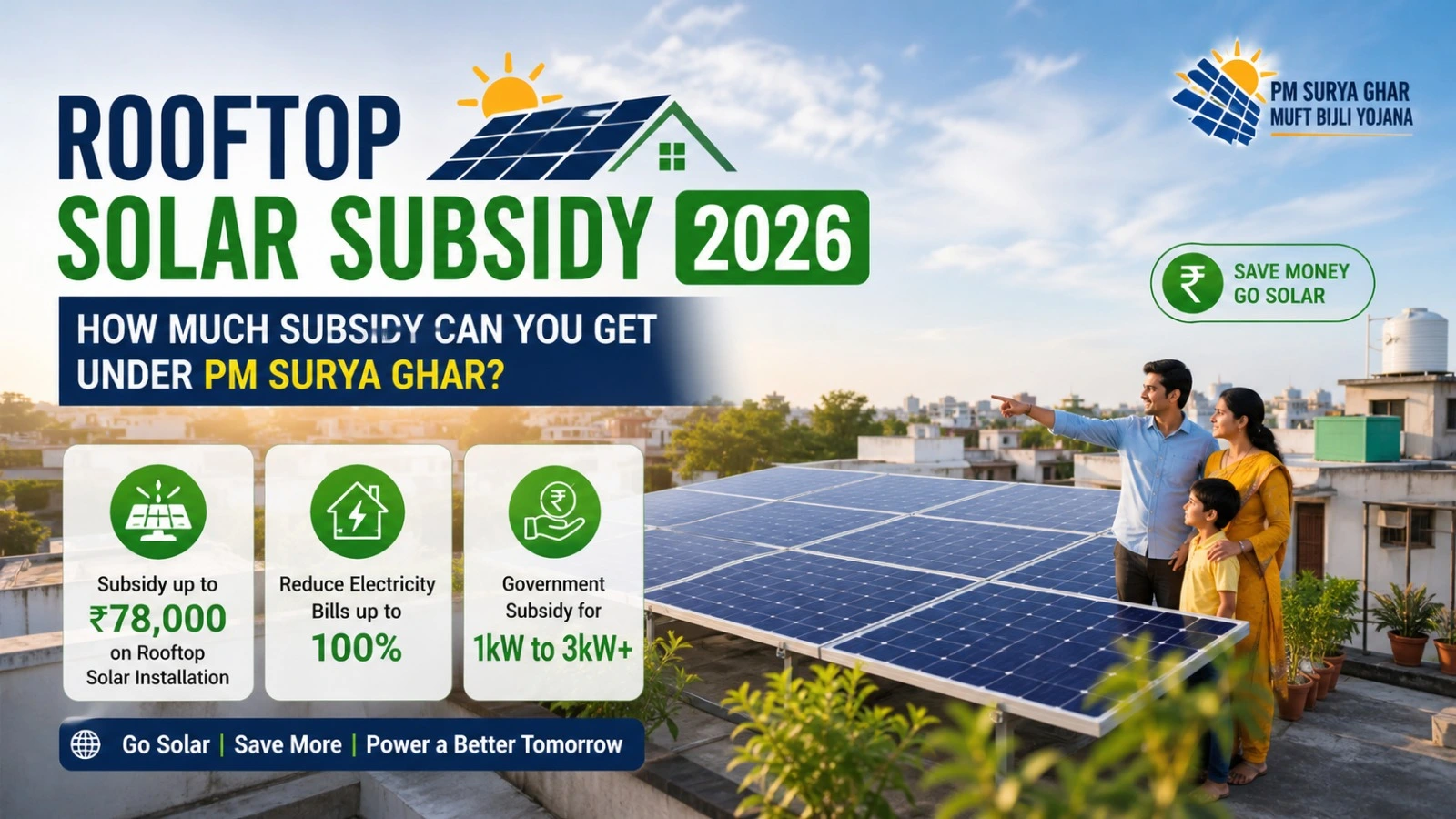
Under the scheme, eligible households can receive a central subsidy of up to ₹78,000 for rooftop solar systems of 3 kW or higher under the standard subsidy structure. The actual benefit depends on the installed capacity, eligibility conditions and completion of the required verification process.
Here is a simple guide to the rooftop solar subsidy in 2026, including the subsidy amount, eligibility, application process and official portal.
What Is the PM Surya Ghar Muft Bijli Yojana?
PM Surya Ghar: Muft Bijli Yojana is a Government of India initiative launched in February 2024 to encourage households to install rooftop solar systems. The scheme aims to support one crore households and help eligible consumers generate their own electricity.
The programme has a total approved outlay of ₹75,021 crore. Its objective is to reduce household electricity expenses and increase the use of renewable energy.
Eligible residential consumers can apply through the official portal and select a registered vendor for installation. The subsidy is transferred to the beneficiary’s bank account after installation and the required checks are completed. <sup>Source: PM India and PIB.</sup>
Official application portal: https://pmsuryaghar.gov.in/
Rooftop Solar Subsidy 2026: How Much Can You Get?
The central financial assistance for eligible residential households follows the standard structure below.
| Rooftop solar system capacity | Central subsidy amount |
| 1 kW | ₹30,000 |
| 2 kW | ₹60,000 |
| 3 kW | ₹78,000 |
| Above 3 kW | Maximum ₹78,000 |
Source: Ministry of New and Renewable Energy (MNRE) and the PM Surya Ghar scheme information.
The subsidy calculation provides ₹30,000 per kW for the first 2 kW and ₹18,000 per kW for the additional capacity up to 3 kW. The central subsidy for an individual residential system is capped at ₹78,000 under this structure.
For example, a household installing a 2 kW rooftop solar system may qualify for ₹60,000 in central assistance. A household installing a 3 kW system may qualify for ₹78,000.
These amounts are subsidy benefits, not the total installation cost. Consumers must check the vendor’s quotation, equipment specifications and any additional expenses before proceeding.
Who Is Eligible for the Rooftop Solar Subsidy?
Applicants should check the scheme requirements before purchasing solar equipment or arranging installation.
The main eligibility conditions include:
- The applicant must be an Indian citizen.
- The household must have a suitable rooftop for solar panel installation.
- The property must have a valid residential electricity connection from the relevant distribution company (DISCOM).
- The applicant must follow the scheme’s technical requirements and installation procedure.
- The household must not have already received another subsidy for the same solar installation.
The subsidy is intended for eligible residential consumers. Commercial and industrial electricity connections should not assume that they qualify under the same residential subsidy structure.
Applicants should confirm their eligibility and any updated requirements on the official portal before making a financial commitment.
How to Apply for PM Surya Ghar Subsidy Online
Eligible households can follow these steps to apply for rooftop solar assistance in 2026.
Step 1: Visit the official website
Open https://pmsuryaghar.gov.in/ and choose the consumer registration option.
Step 2: Register your electricity connection
Select your state and electricity distribution company. Enter the required electricity consumer number, mobile number and email address.
Step 3: Submit the rooftop solar application
Log in using the requested details and complete the application form. Provide accurate information about your electricity connection.
Step 4: Wait for feasibility approval
Follow the portal’s instructions and wait for the necessary approval before proceeding with installation.
Step 5: Select a registered vendor
Choose an eligible vendor listed on the portal. Confirm the system capacity, equipment specifications, installation cost and warranty terms in writing.
Step 6: Complete installation and inspection
After installation, submit the required system details and follow the instructions for net metering and inspection by the DISCOM.
Step 7: Submit bank details
Once the required commissioning documentation is available, submit the requested bank account information and supporting documents through the portal.
The subsidy is released after the required checks and approval. Do not assume that payment will arrive immediately after installation; processing time can depend on verification and application status.
Important Details at a Glance
| Particular | Details |
| Scheme name | PM Surya Ghar: Muft Bijli Yojana |
| Implementing ministry | Ministry of New and Renewable Energy |
| Maximum standard central subsidy | ₹78,000 per eligible residential household |
| Eligible beneficiaries | Qualifying residential electricity consumers |
| Application mode | Online |
| Official portal | https://pmsuryaghar.gov.in/ |
| Subsidy payment | Bank transfer after required verification |
| Scheme launch | February 2024 |
There is no single application deadline stated here for all consumers in 2026. Applicants should check the current portal and relevant state DISCOM notices for availability, updated procedures and any applicable conditions.
How Much Electricity Bill Can You Save?
The savings depend on how much electricity your household consumes, the solar system’s generation, local sunlight conditions, roof orientation and the applicable electricity tariff.
A properly sized rooftop solar system can reduce the amount of electricity purchased from the grid. However, solar installation does not automatically mean that every household will receive a zero electricity bill. Fixed charges, consumption patterns, net-metering rules and other billing provisions may still apply.
Before choosing a system, compare your previous electricity bills with the expected generation and installation cost. Ask the vendor to explain the estimated payback period rather than relying on general savings claims.
Important Points Before Applying
Keep these points in mind before installing rooftop solar panels:
- Apply through the official government portal.
- Check vendor registration and compare written quotations.
- Confirm that the selected system meets the scheme’s technical requirements.
- Do not pay an agent who promises guaranteed approval or instant subsidy release.
- Keep your electricity consumer details, bank information and installation documents accurate.
- Check application status and official notifications for any changes to the procedure.
For scheme guidelines and additional information, visit the Ministry of New and Renewable Energy.
Frequently Asked Questions (FAQs)
1. What is the maximum rooftop solar subsidy under PM Surya Ghar in 2026?
Eligible individual residential households can receive a maximum standard central subsidy of ₹78,000 for a rooftop solar system of 3 kW or higher.
2. Can I get a ₹60,000 subsidy for a 2 kW solar system?
Yes. Under the standard subsidy structure, an eligible household installing a 2 kW system can qualify for ₹60,000 in central financial assistance, subject to scheme requirements.
3. Where can I apply for the PM Surya Ghar subsidy?
You can start the application through the official portal: https://pmsuryaghar.gov.in/.
4. Is the subsidy available for systems above 3 kW?
The standard central subsidy for an individual residential household is capped at ₹78,000. Installing a larger system does not increase this central subsidy beyond the cap.
5. Does PM Surya Ghar guarantee zero electricity bills?
No. The scheme aims to help eligible households generate solar electricity and reduce their bills. Actual savings and remaining charges depend on electricity consumption, solar generation and local billing rules.
Disclaimer: This article is for general informational purposes. Subsidy amounts and procedures should be confirmed through the official PM Surya Ghar portal, MNRE guidelines and the relevant electricity distribution company before installation.